Philip Francis Queeg
The Caine MutinyPhilip Francis Queeg’s command of the fictional USS Caine turns the problem of naval authority into a conflict over judgment: he demands exact control to prevent a mistake, yet his rules, suspicion, and conduct under pressure help undermine confidence in his command. The novel portrays a consequential fictional officer, not a portrait of a real serviceman or a representative military type; its prefatory notice also cautions that historical and naval details have been altered.
Arrival and Commanding Manner
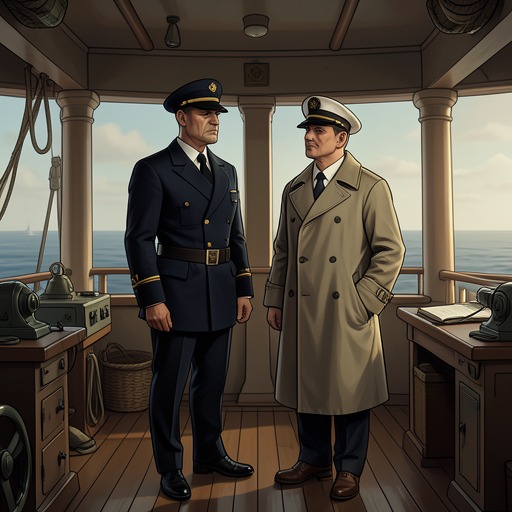
Queeg reports aboard the USS Caine as a lieutenant commander the morning after Willie Keith’s first difficult impressions of life on the ship. At the wardroom introduction, Captain de Vriess presents Ensign Keith to the new commander. Keith has hurried into his cleanest uniform and is still sucking the thumb he injured while changing his collar pins, a small detail that establishes his youth and awkwardness beside the formal transfer of authority. Queeg’s arrival marks a change in the ship’s leadership, but the scene offers no separate account of his earlier life or career.
At his first meeting with the officers, Queeg adopts an easy, joking manner. He sits at the green-covered wardroom table, sets out a fresh pack of cigarettes and matches, and takes out Queeg’s Steel Balls, rubbing them between his fingers as he speaks. His attention repeatedly returns to the cigarette or the balls rather than to the faces around the table. The small repeated gesture becomes a visible feature of his presence: even in a social setting, he appears preoccupied with his own thoughts and concerns.
A Command Built Around Avoiding Mistakes
Queeg explains his governing fear to Tom Keefer: a commanding officer, he believes, gets only one chance to make a mistake, and others are waiting for him to make it. He vows not to give them that opportunity. In the same discussion he objects to relying on another ship to stand guard, citing his own radio crew’s discipline as something he can control and the other ship’s sailor as someone he cannot. His proposed response is to have the USS Caine stand its own guard continuously. The episode shows how a concern about accountability turns into an insistence on personally controlling the conditions around him.
That insistence shapes the ship’s daily rules. After an order is posted, Queeg finds a cigarette butt in a forecastle scupper the next morning and cancels liberty for the entire crew. For the following days, the deck force keeps the main deck swept; once the USS Caine sails for Kwajalein, the order is largely set aside and the deck returns to its prior condition between sweepings. One sailor, however, is assigned to keep clean the small area between Queeg’s cabin, the bridge ladder, and the wardroom hatch. The response is less a lasting change to the ship than a localized performance of compliance.
The crew’s adaptation becomes the Circle of Compliance: sailors track Queeg’s habits and keep his rules within the range of his eyes and ears, while much of the ship carries on as before beyond that range. When he ventures outside this informal boundary, a disturbance can prompt another rule, which is then observed within his immediate reach and ignored elsewhere. The narrative stresses that this pattern is not a coordinated conspiracy. It emerges from the ship’s routines and the crew’s individual adjustments, making Queeg’s attempt to impose uniform order produce a conspicuously uneven one.
Command Under Operational Pressure
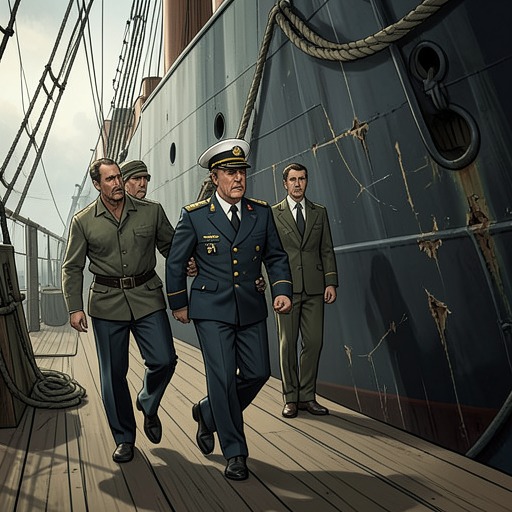
During the USS Caine’s grounding in the West Loch, the ship’s movement damages USS Moulton (DMS-21): the Caine’s anchor tears along the other ship’s forecastle and bridge, while a gun scrapes its side and equipment falls into the water. Queeg shouts wheel and engine orders amid the confusion. The USS Caine ends up stuck by the stern in the mud. The account supplies the immediate damage and outcome but does not isolate a single order as the cause; the episode nevertheless places Queeg’s command amid a breakdown that affects both ships.
A later target-towing run presents a different kind of public uncertainty. After the USS Caine has steamed partly around a circle for a second time, the target appears ahead again. Queeg sees it, reacts with surprise, and rushes into the wheelhouse to question the ship’s position and what the helmsman, John Stilwell, is doing. The scene shows him confronting an apparent failure of navigation without first demonstrating that he understands how it occurred. Rather than clarifying the situation, his questions and alarm make the uncertainty visible to those around him.
The strain of command also accumulates through ordinary work. During a stretch of rough weather, officers move between watches, coding, correcting publications, meals, and sleep in the clipping shack, while Queeg repeatedly rolls his balls and makes occasional comments about work requests. Across longer months aboard ship, the routine expands into watchkeeping, logs, reports, and audits under heat, rain, and changing weather. These passages place Queeg’s authority in a closed working environment where crew members have little separation from duty and where even small rules can govern shared space and time.
Relief During the Storm
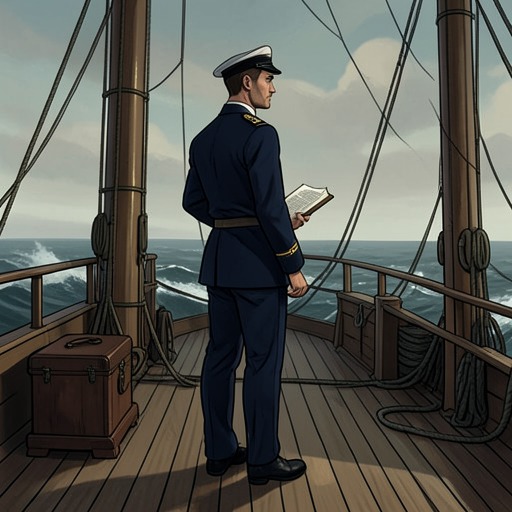
The decisive rupture comes during the storm of December 18, 1944. As the minesweeper careens and sideslips, Steve Maryk tells Queeg that the USS Caine is not answering to the rudder and proposes using the engines and heading into the wind. At the same moment, Maryk orders the ship steady. The helmsman looks between the two officers; Maryk insists that he be obeyed, tells Willie Keith to note the time, then salutes Queeg and declares that the captain is sick and that he is temporarily relieving him under Article 184 of the Navy Regulations.
Queeg later says that he is resuming the conn and that the matter should be set aside until the storm has abated. The account thus records both the intervention and Queeg’s return to command, rather than treating the relief as an uncontested, permanent transfer at that moment. Maryk’s decision becomes the basis of the court-martial, where the distinction between an officer’s authority and the responsibility to act in an emergency is put on trial along with Maryk himself.
Testimony and the Limits of Diagnosis
Queeg is the first witness called at Maryk’s court-martial. Dr. Forrest Lundeen, chief of psychiatry at the Navy hospital and head of the medical board that examined him, gives a qualified assessment: he identifies Queeg’s personality as paranoid but says that the condition is not disabling. The testimony therefore supplies a clinical description without establishing, on its own, that Queeg was unable to command. The novel preserves a distinction between a personality diagnosis and the legal or practical question raised by the storm.
When Steve Maryk recounts the morning of December 18, his account is described as repeating Willie Keith’s version. Barney Greenwald asks whether the ship was in the last extremity when Maryk relieved the captain. The question puts the crisis’s severity, rather than Queeg’s manner alone, at the center of the defense’s inquiry. Queeg, for his part, characterizes the court-martial as a conspiracy by Keith and Maryk to discredit him. He then moves through complaints about the laundry, mess statements, ship’s-service inventories, and the conduct of his officers, especially Maryk and Keith. His testimony becomes increasingly difficult to follow as he shifts between subjects, times, and places while rolling Queeg’s Steel Balls.
Under questioning about a lost crate, Queeg pauses to think and corrects an earlier misstatement: he recalls losing a crate of clothes in San Diego Harbor in 1938 or 1939 under similar circumstances, while the crate Keith lost contained liquor. The correction is concrete, but it does not resolve the broader dispute about his conduct or the storm. Greenwald returns to the central issue by asking whether the USS Caine was in the last extremity when Queeg was relieved; the supplied account records the question, not an answer. The testimony’s force lies partly in this unresolved collision between Queeg’s grievances and the court’s test of the emergency.
Aftermath and Significance
Willie Keith later reports that Maryk was acquitted, largely through legal maneuvering, and that Keith’s own case was dropped. By then, Queeg has been relieved by an Academy-trained commander who straightens out the ship over four months before handing it to Tom Keefer. The report does not describe Queeg’s subsequent career, but it establishes that he no longer commands the USS Caine. Keith also says that he has come to feel sorry for Queeg, whom he regards, along with Stilwell, as a victim of war. That later judgment does not erase the harm and conflict associated with Queeg’s command; it changes the emphasis from simple blame to shared damage.
Queeg’s arc is built from a recurring contrast between control as he intends it and control as the ship actually experiences it. He wants to prevent the one mistake that could ruin a commander, but the rules he creates invite selective obedience, and his conduct in moments of uncertainty becomes part of the case against him. The medical testimony resists an easy equation between paranoia and incapacity, while the court-martial makes the consequences of command behavior inseparable from the question of emergency. The novel’s prefatory disclaimer is important here: Queeg is explicitly a fictional figure, devised to motivate the central situation rather than offered as a real-life portrait or general diagnosis of naval officers.